41MC296: Historic Indian Encampment on the Banks of Elm Creek
Site MC296 on Elm Creek in McMullen County provides a rare south Texas example of a native encampment at the time of early European contact. Explorers and Spanish travelers made their mark and began changing native life in many ways, including the introduction of metal tools and implements. At MC296, the rusted fragment of a metal knife was found in near-surface deposits along with traditional, native-made chipped-stone tools. Called a “case knife,” the metal item was popular in Indian trade during the 18th century and is similar to those found in mission sites in south Texas and northeastern Mexico. Among the stone tools was a small, triangular Guerrero arrow point, a type manufactured by native peoples during the Historic Period. The type has been attributed primarily —if not predominantly—to those peoples brought into mission settings for conversion by the Spanish. The “type sites” for this point style are the Gateway missions along the Rio Grande in Guerrero, Mexico. Other native items found in these late deposits were Perdiz arrow points, large, chipped-stone beveled knives, and bone-tempered pottery.
Site MC296 was excavated in 1981 by archeologists from the Center for Archaeological Research at the University of Texas at San Antonio. Located on the banks of Elm Creek just upstream from its juncture with the Frio River, the site is well located for exploitation of diverse resources, including various plants and animals as well as sandstone outcrops for cookstone. Evidence of multiple, earlier human occupations at the site spanning some 2000 years also was found.
The upper deposit, however, was radiocarbon dated to A.D. 1430 to A.D. 1610, and can be attributed to very late, Late Prehistoric “Toyah” horizon peoples and/or Historic Indian groups camping at the site just as Europeans began entering the region. Perdiz arrowpoints, bevelled knives, and bone-tempered ceramics, such as were found in the upper deposit, are diagnostic of this period. In advance of the Spanish entrada and more permanent settlements in the region, native peoples from distant areas began bringing in and trading European items with South Texas’ native peoples. The metal knife may have been such an item. It is sobering to note that along with these “modern” implements and technologies came European diseases, for which the vulnerable natives had no immunity.

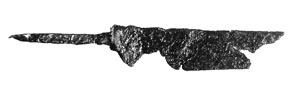
This rusted fragment of a metal knife is an example of the many items
brought by Europeans for trade with Indians. Called a “case knife,” this item was popular in Indian
trade during the 18th century. Photo courtesy CAR-UTSA.  |
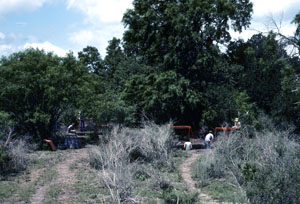
Excavations underway in 1981 at site 41MC296. In addition to late
evidence near the surface, archeologists unearthed evidence of earlier occupations by native peoples
practicing much the same lifeways. Photo courtesy CAR-UTSA. |