 University of Texas at Austin
 College of Liberal Arts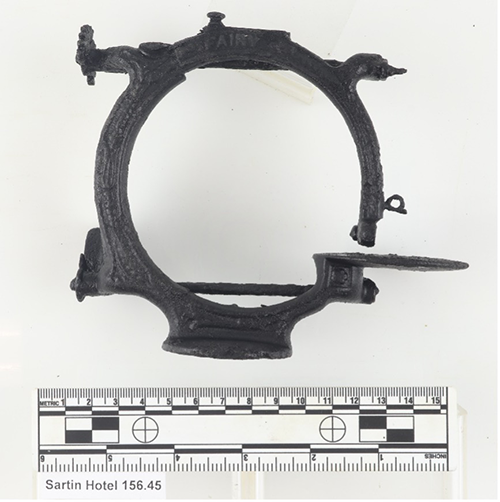
Object: Secor Fairy, a miniature cast-iron sewing machine
Date: Manufactured by the Secor Sewing Machine Company in the early 1880s and used in the 1880s or 1890s
Context: Bolivar, Texas, Denton County, Sartin Hotel (41DN593)
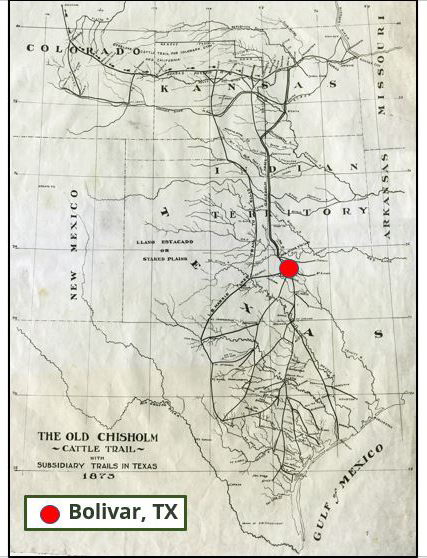
Archeologists recovered this small, hand-cranked sewing machine at the site of a late 19th-century hotel in Bolivar, Denton County, Texas. Bolivar was a prominent town on the Chisholm Trail, a famous cattle drive route between Texas and Kansas, as well as along stagecoach and mail routes. Travelers streaming through Bolivar needed a place to stay, and many were accommodated at the Sartin Hotel.
The Sartin Hotel was likely established sometime in the 1870s, certainly by 1881, and was in operation through 1899, if not later. The hotel’s namesake, Jesse Sartin, was the building’s second owner and he ran the hotel for many years. Sometime in the early 20th century, the two-story wooden structure was abandoned, fell into ruins, and was removed. By the late 20th century, the Sartin Hotel site was all but forgotten.
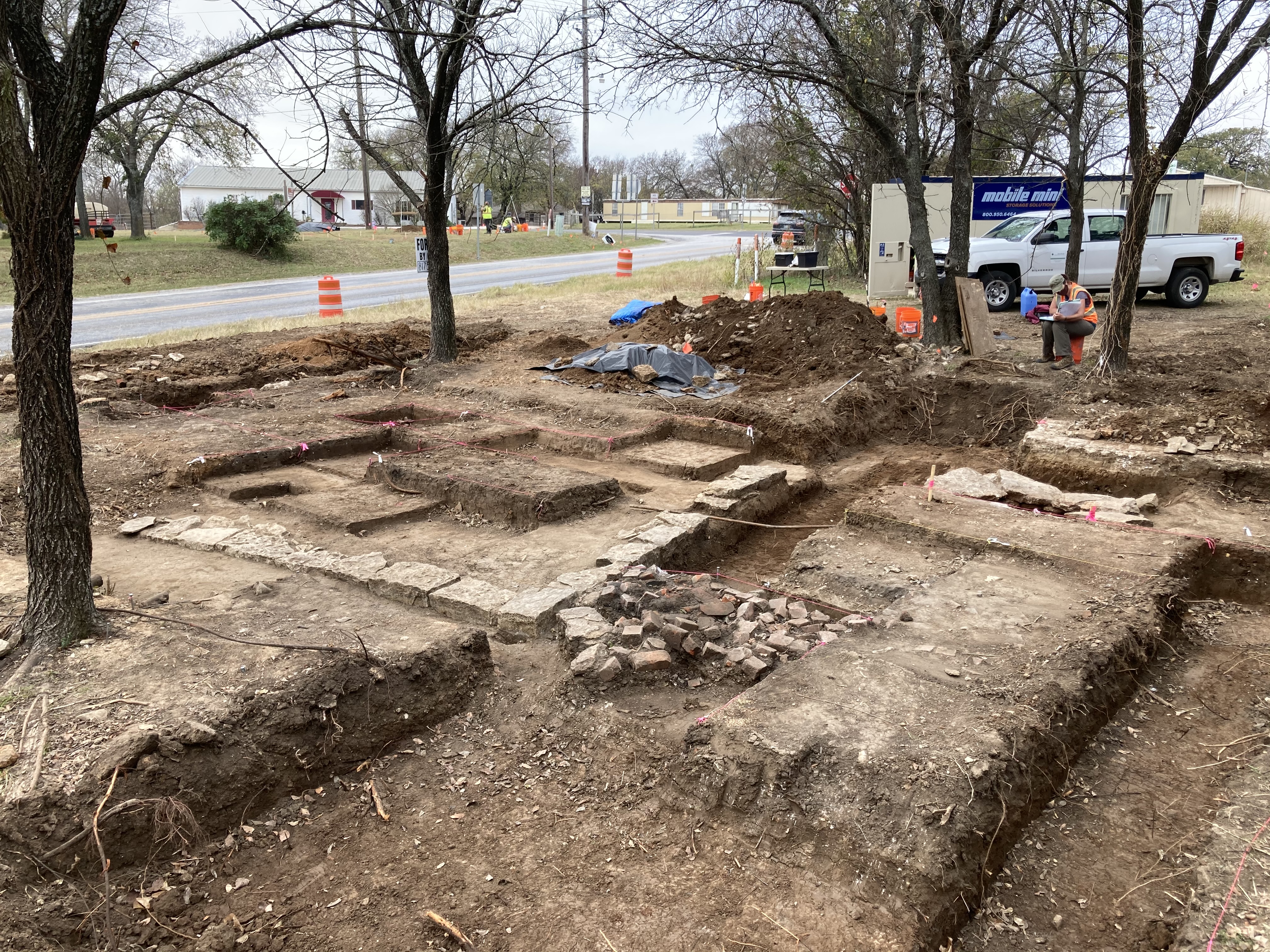
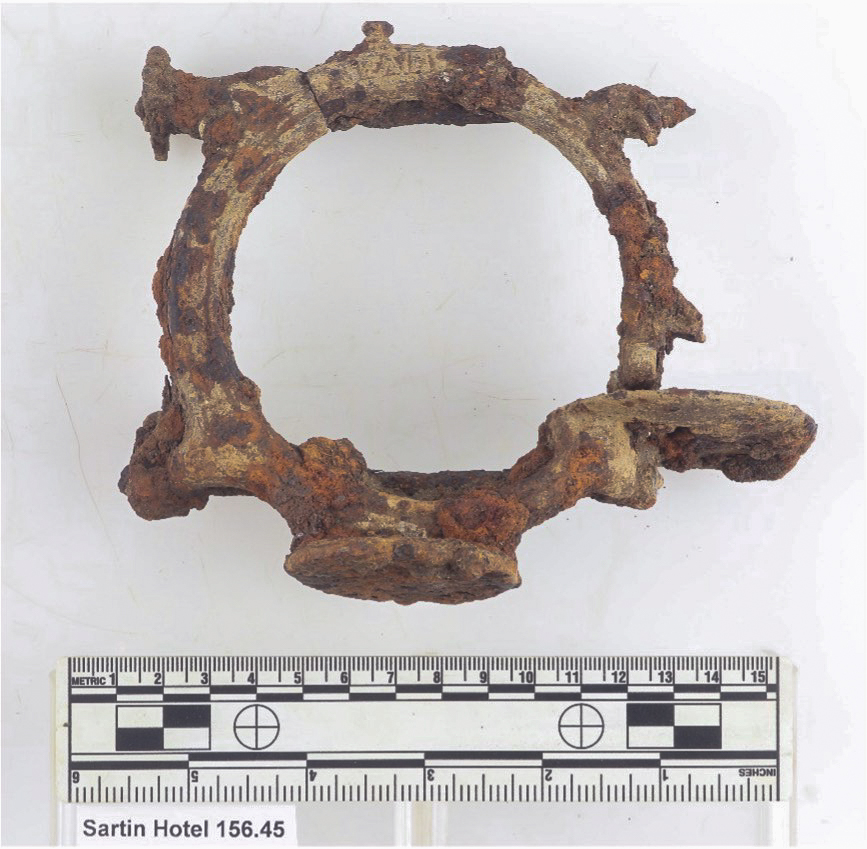
The Texas Department of Transportation sponsored excavations at the site of the Sartin Hotel in the fall and winter of 2020-2021. Archeologists from Stantec, Inc. were contracted to lead the project, but these highly trained experts neither found nor identified the artifact. North Texas Archeological Society members volunteering on the site found it while screening machine-excavated fill. Upon its discovery, no one had any idea what the diminutive, corroded iron hoop was. Months later, back at Stantec’s archeology lab, professional blacksmithing consultant Kelly Kring hazarded a guess. “I think it’s a sewing machine,” he said hesitantly. A few hours of internet sleuthing later, Stantec archeologists verified Kring’s assertion - this unusual object was confirmed to be the Secor Sewing Machine Company’s “Fairy” model.
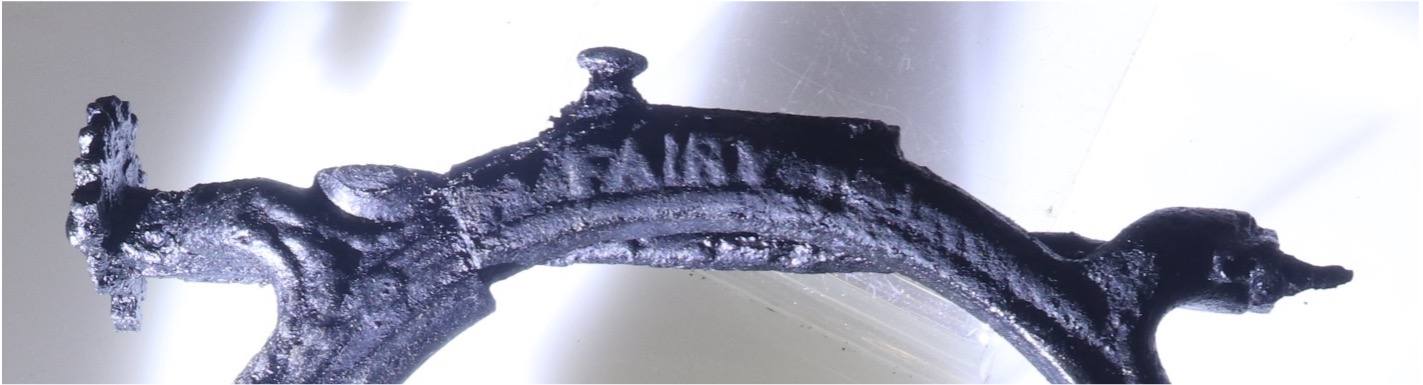
The Fairy measures a diminutive 6 inches wide and 5 inches tall and sits upright on a round base. Its body is a circular cast iron frame with a horizontal plate, and several gears and shafts moved the sewing needle when the crank was turned. The specimen recovered from the Sartin is missing its crank handle and the bottom clamp that would attach it to a table.
The Secor Sewing Machine Company was founded by a famous toy maker, Jerome B. Secor, and operated in Bridgeport, Connecticut from ca. 1876 or 1877 to 1883 (various sources disagree on the founding date, but all seem to agree the company ceased operations in 1883). The Fairy sewing machine, known as the Secor Fairy model, may look like a toy, but it was a highly portable and fully functional, affordable, hand-cranked sewing machine that could be clamped onto any flat table or bench. J. B. Secor filed for a patent on October 5, 1882, and his Fairy was granted U.S. Patent number 282,674 on August 7, 1883 and an additional U.S. Patent (number 286,336) was granted to him on October 9, 1883, for a “Sewing Machine Tension” mechanism. In the description for Patent number 282,674, Secor claimed:
My invention is a sewing-machine constructed, as fully described hereinafter, in order to reduce the cost of manufacture and secure such a simple and effective structure as will enable the same to be sold at a lower price than those made in the ordinary manner.
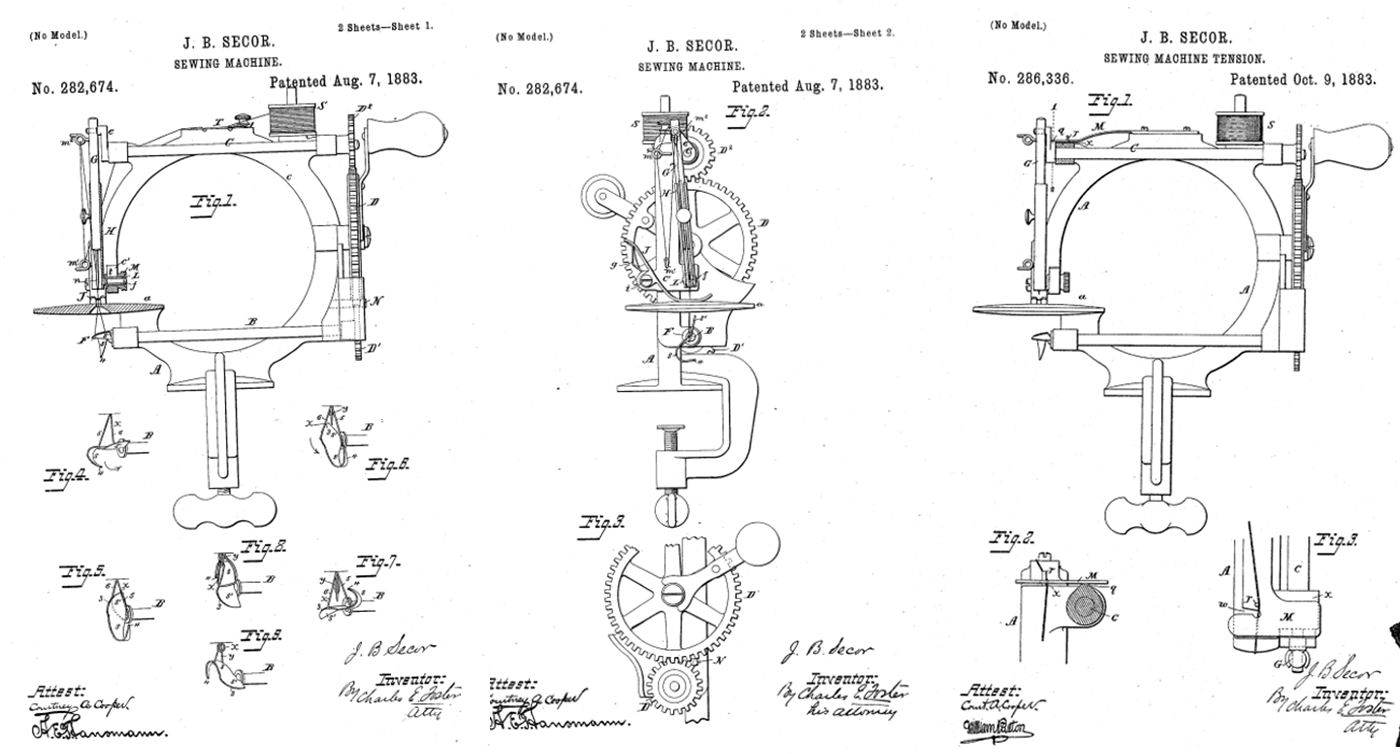
Among sewing machine collectors, the Secor Fairy model is acknowledged as a rare item. Images and descriptions of well-preserved originals reveal “it is made [of] cast iron, wood and brass, and it was operated by a hand crank that also moved the walking foot to advance the material,” as described by Mike McLeod in his post on “Southeastern Antiquing and Collecting Magazine.”
As with many archeological finds, the Fairy leaves us with more questions than answers. How did this Secor sewing machine end up in the archeological deposits at this late 19th-century hotel site in Bolivar, Texas? Who owned and used the Secor Fairy sewing machine? Perhaps this remarkably portable machine belonged to a traveler who accidentally left it behind or intentionally discarded it after it broke. Or perhaps clothing repair was one of the services the hotel offered its traveling patrons, and it was discarded by hotel staff after it broke. Or, was it lost and damaged years after the hotel was abandoned and gone? Was the sewing machine still functional but was abandoned because it had become obsolete, and its owner no longer needed it?
Throughout its history, the story of Bolivar has been intimately tied to transportation. The Sartin Hotel, like Bolivar itself, owed its existence to the presence of roads, stagecoach lines and mail routes, and the Chisholm Trail. Bolivar was a crossroads frontier town, and these transportation routes brought travelers to the doorstep of the Sartin Hotel.
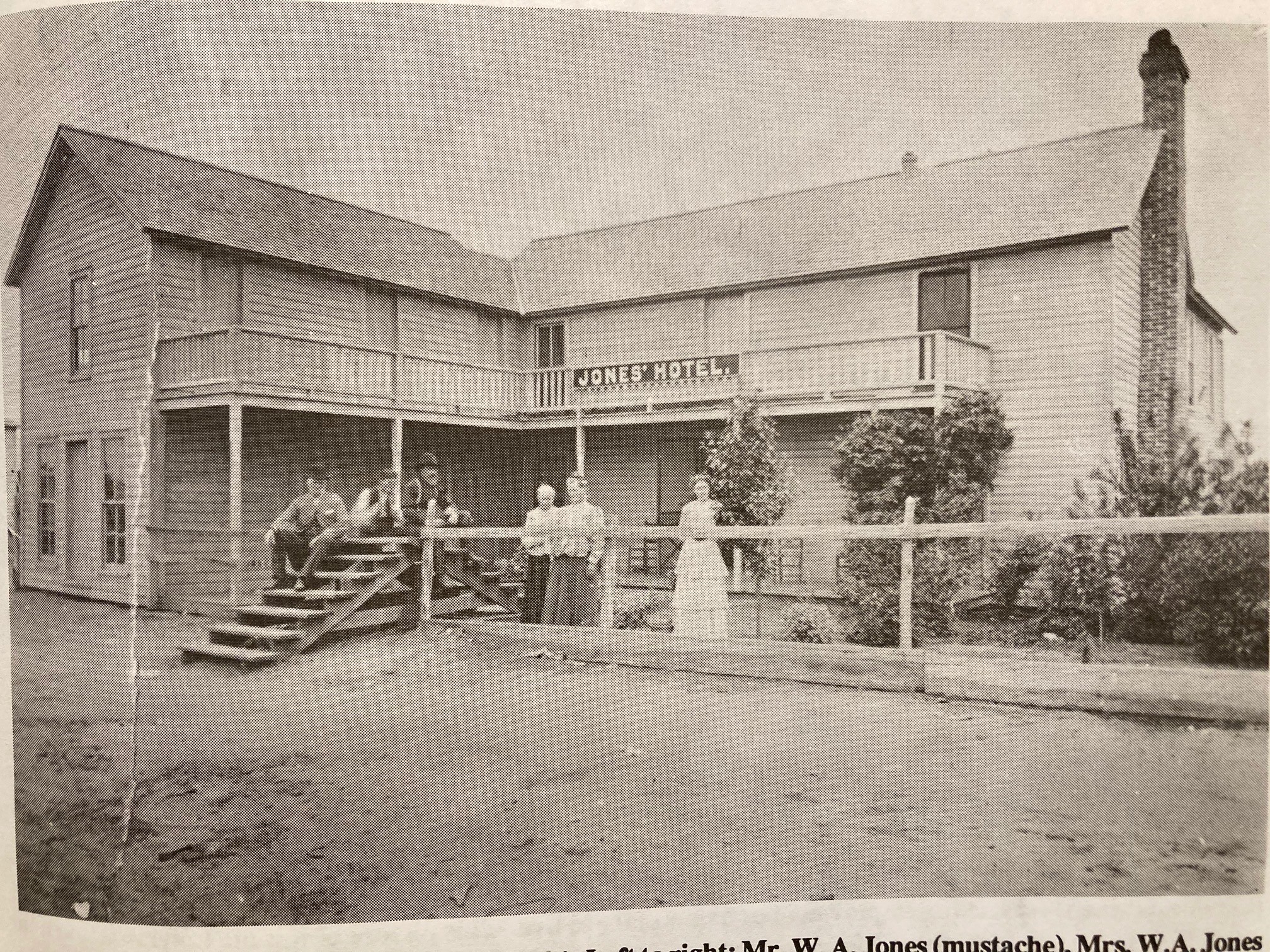
The Sartin Hotel was fondly remembered in the early decades of the twentieth century by former residents of Bolivar. They recalled the hotel as a “rambling,” two-story, L-shaped, wood-frame building. A few people recalled the Sartin Hotel had a flowing well or “duck pond” in the hotel lobby, but these details could not be verified through period archival records or archeological evidence. No photographs of the Sartin Hotel, interior or exterior, have been found so we have no way of knowing exactly what it looked like.
Following a common theme in Texas’ history, Bolivar reached its commercial peak in the early 1880s but then began a slow decline starting in 1886 when the Gulf, Colorado & Santa Fe Railroad was built through Denton County. The railroad line bypassed the town by about five miles, and many of Bolivar’s people and businesses were drawn away to the new town of Sanger and other towns along the railroad. The Sartin Hotel was certainly impacted by this event, but the details of its history after the arrival of the railroad remain unknown.
While we can never know all its secrets, the Secor Fairy sewing machine was one of many labor-saving devices patented after the Civil War. This unusual artifact reflects rapidly changing times and technologies as the industrial revolution made its way onto the Texas frontier.
Credits
Exhibit prepared and authored by Alex Menaker, Douglas Boyd, and Alana Vidmar of Stantec Consulting Services Inc. (Stantec) and edited by Emily McCuistion and TBH editor Steve Black. Unless otherwise stated, images used courtesy of the Texas Department of Transportation, Environmental Affairs Division, Cultural Resources Section.
Alex Menaker is a Senior Archeologist with Stantec and Research Fellow with the University of Texas, managing archeological projects across the United States. His role as a Co-Principal Investigator on the collaborative and public Bolivar Archeological Project highlights his commitment to community engagement and historic preservation. Additionally, Dr. Menaker has conducted archeological research across the Americas and received his PhD from the University of Texas, with research involving a multidisciplinary and community engaged project in the Southern Peruvian Andes.
Douglas Boyd is a Senior Archeologist with Stantec and has been engaged in CRM archeology in Texas since 1975. He has a BA degree from West Texas State University (now West Texas A&M) and an MA degree from Texas A&M. He works with the nonprofit Plains Archeological Research and is currently involved in studies of prehistoric architecture of Southern Plains villagers. He is also a Fellow of the Texas Archeological Society and has helped co-direct the youth group archeology at the annual summer field school for the past 25 years. Mr. Boyd also serves on the Antiquities Advisory Board and the Texas Preservation Trust Fund advisory board to the Texas Historical Commission. At Stantec, Mr. Boyd is a Co-Principal Investigator for the Bolivar Archeological Project and a proponent of community-based archeology.
Alana Vidmar is an Associate Architectural Historian at Stantec, and she serves as one of the project historians for the Bolivar Archeological Project. She received a BA degree from the University of Washington and an MSc degree from the University of Bath (England). She has experience in several states supporting a variety of clients in compliance with Section 106 of the National Historic Preservation Act of 1966 (NHPA), as amended, National Register of Historic Places (NRHP) evaluations and nominations, and various state historic property inventories. She enjoys and is particularly committed to thorough historical research using a number of primary and secondary sources.
Print and Online Sources
Best, David G.
2017 A-Z of American Sewing Machine Manufacturers. Copyright by David G. Best. Electronic document, http://www.sewmuse.co.uk/american%20sewing%20machine%20manufacturers.htm#s, accessed May 1, 2025.
Der Schilingenfänger
2024 Der Schilingenfänger. Web Site des Vereins "Sammlerfreunde Historischer Nähmaschinen" [The Shingle Catcher. Website of the association "Collectors of Historical Sewing Machines"]. Electronic document, http://www.schlingenfaenger.de/hh-nm-usa-l-v.html, accessed May 1, 2025.
McLeod, Mike
2015 Secor Fairy Sewing Machine. Answer to Name this Famous Antique Game. Online post at Southeastern Antiquing and Collecting Magazine. December 2015. Electronic document, http://www.go-star.com/antiquing/famous-antiques1215.htm, accessed May 1, 2025.
Shelton, Hooper
1973 From Buffalo to Oil: History of Scurry County, Texas. Scurry County Historical Survey Committee.
Smithsonian Institution Librariesa
2001 Sewing Machines: Historical Trade Literature in Smithsonian Institution Collections. A Smithsonian Libraries Publication. Electronic document, https://www.sil.si.edu/DigitalCollections/trade-literature/sewing-machines/pdf/sewing-machines.pdf, accessed May 1, 2025.
2022 Sewing Machines: Historical Trade Literature in Smithsonian Collections. Online listing of the Smithsonian Libraries, Digital Collections. Electronic document, https://www.sil.si.edu/DigitalCollections/trade-literature/sewing-machines/cf/single-recordonpiece.cfm?CompanyName=Secor%20Sewing%20Machine%20Co%2E, accessed November 28, 2022.
TxDOT
2025 Bolivar: The Once Wild West. Website for the Bolivar Archeological Project sponsored by the Texas Department of Transportation, Environmental Affairs Division, Cultural Resources Management Section. Electronic document, https://www.txdot.gov/about/campaigns-outreach/archeology-history/txdot-archeology/bolivar.html, accessed May 1, 2025.
U.S. Patent Office
1883a Sewing Machine. United States Patent No. 282,674, patented August 7, 1883. United States Patent Office, Electronic document, https://patents.google.com/patent/US282674A, accessed November 28, 2022.
1883b Sewing Machine Tension. United States Patent No. 286,336, patented October 9, 1883. United States Patent Office, Electronic document, https://patents.google.com/patent/US286336A, accessed November 28, 2022
Wolfegang’s Collectibles
2019 Secor Fairy Integral Clamp Hand Crank Sewing Machine. Facebook post on Wolfegang’s Collectibles. Electronic document, https://www.facebook.com/media/set/?set=a.2547037612011007&type=3&comment_id=2551047438276691&_rdr, accessed May 1, 2025.