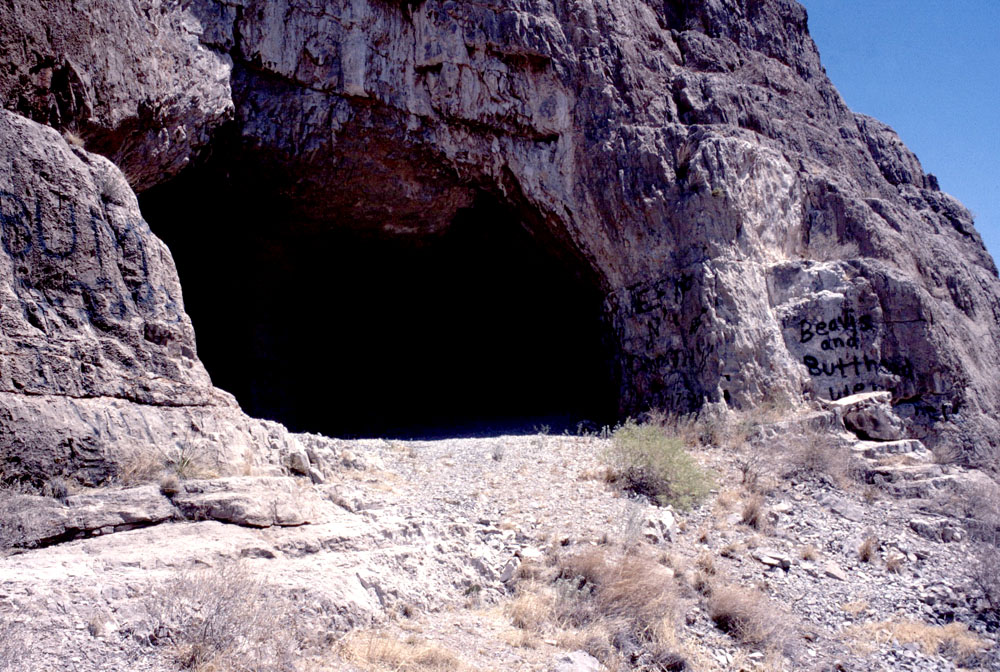
For at least a thousand years, a narrow canyon in the Hueco Mountains near El Paso sheltered one of the earliest known shrine caves in the greater American Southwest, a site that has come to be known as Ceremonial Cave. Although many such caves have been found in Arizona and New Mexico, Ceremonial Cave is notable for its unusually early use as a shrine, as well as for its location in Texas, near the eastern margin of the Puebloan interaction sphere.
The significance of shrine caves is rooted in ancient belief systems about human origins. Modern Pueblo people believe that caves are important as places of emergence and as portals to a watery underworld. Ancient puebloans used specially designated caves for rituals associated with specific seasons and activities. Most had both summer and winter shrine caves, where designated individuals would place offerings and perform other rituals. Depending on the nature of the visit and season of the year, the rituals performed in the caves typically involved use of prayer sticks (also known as pahos) and other painted and ornamented objects.
Offerings found at Ceremonial Cave indicate that it may be one of the earliest in the Southwest to have been used as a shrine (another is Correo Snake Pit in Central New Mexico). Their earlier use is indicated most notably by the presence of spear, atlatl, and fending stick offerings. At Ceremonial Cave, we now know that placing of spears as offerings began about 2000 years ago, if not centuries earlier, and continued for at least a millenium.
During this long period of time, a number of objects were placed there deliberately during ritual activities, their richness and diversity as a group unparalleled in this region. Along with ornaments of turquoise, shell, and obsidian, prayer sticks, and spears were more puzzling items and deposits. Some of these may be the day-to-day trappings and debris left behind by much earlier peoples who visited and perhaps stayed briefly in the cave. These visits—long before the cave's more specialized use—probably spanned thousands of years.
Much of what we know of the site we call Ceremonial Cave harks back to accounts from the 1920s and 1930s, with our best source of information being the investigations by the Harvard University research team led by C.B. and H. S. Cosgrove. Beyond that and the few other descriptions left us, the story of Ceremonial Cave is told largely, but very imperfectly, by the artifacts collected through the years by looters and archeologists alike.
New Research
Recent studies of artifacts curated at the Texas Archeological Research Laboratory and the Peabody Museum at Harvard University are helping to unlock some of the secrets of Ceremonial Cave nearly a century after its excavation. Analytical techniques, such as AMS dating and high resolution X-ray computed tomography (CT) scanning, now afford researchers the opportunity to examine some of the rare and perishable items with minimal damage to the objects. These materials —cane and wood spear shafts, foreshafts, and "pajo" or prayer sticks—constitute one of the largest collections of such objects from the Southwest. Rarely found intact, the hafted darts and "prayer sticks," in particular, hold promise for helping us better understand the technology and ritual traditions of the desert cultures.
AMS radiocarbon dating of hafting on several of the darts reinforces indications that the offerings were left by peoples of the Jornada-Mogollon culture. CT scans of the hafted darts provide a clear image of each chipped-stone point and allow researchers to determine their shape and style and even examine aspects of hafting technology. The combination of projectile point form and chronometric age helps fine tune the dating of specific projectile point styles in the American Southwest and approximate a timeline for some of the events which took place there.
In This Exhibit
In the following sections we take a closer look at what is known about Ceremonial Cave. Site Discovery traces the efforts of an El Paso area couple to have the site documented, excavated, and protected from relic collectors who had already destroyed much of the cave's deposits. Artifact Gallery provides examples of the hundreds of artifacts recovered from the site and considers the meaning, both sacred and mundane, of these diverse items. Hafted Dart Points reports on recent analyses of the remarkably preserved weapons including CT scans and radiocarbon dating. In this interactive section, viewers can study the objects through a series of rotating “movies” with 3-dimensional details generated for each dart point. These include complete views of the dart point basal sections hidden beneath the hafting materials.
What We Have Learned summarizes our current understanding of Ceremonial Cave and what might be learned through additional research. Credits and Sources acknowledges contributions of authors and researchers and lists sources for additional information.
|
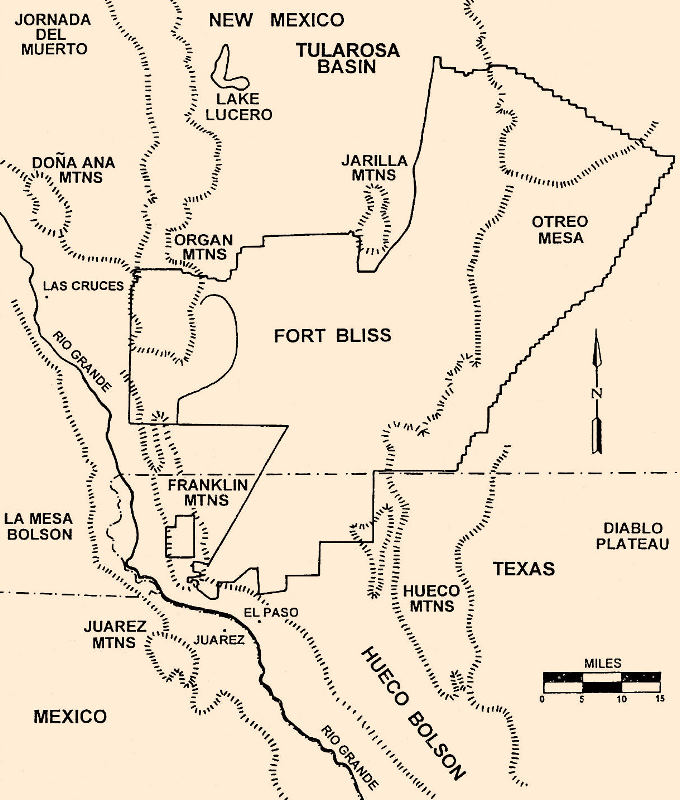
Ceremonial Cave is located in the Hueco Mountains, which form the northeastern border of Fort Bliss in the Trans-Pecos region. Map adapted from Hawthorne-Tagg et al., 1998: Fig. 1.  |
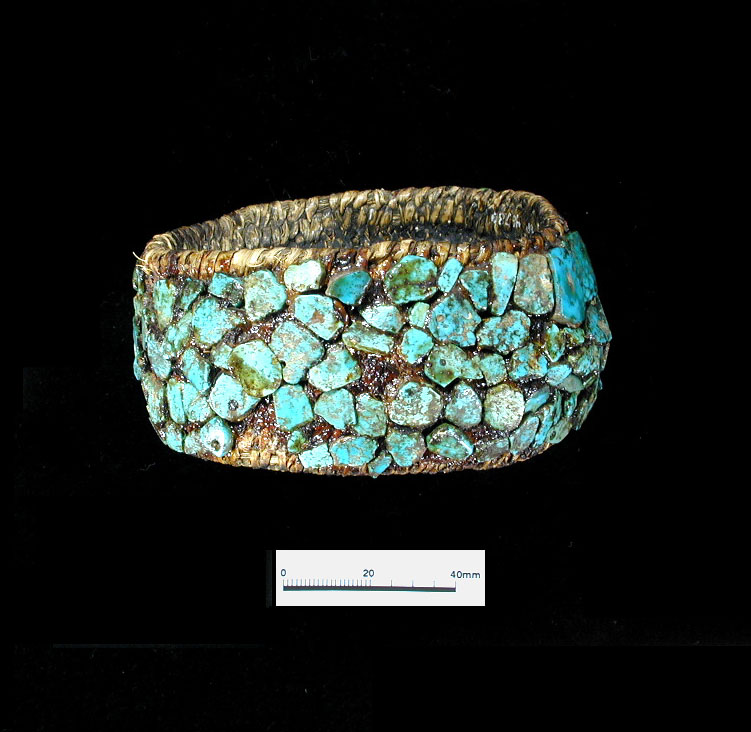
A finely crafted turquoise basketry armband was
one of the unique items found in the cave. Photo by
Milton Bell. TARL collections. |
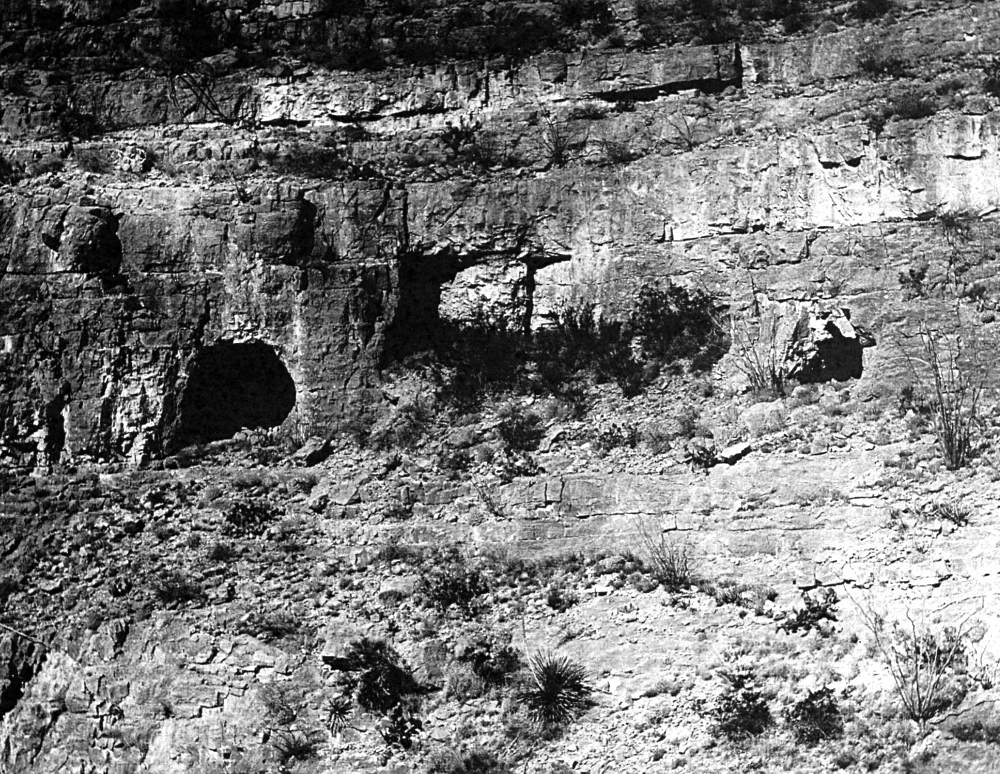
Late 1920s view of Ceremonial Cave. Photo by Jim Alexander, courtesy of Richard D. Worthington and El Paso County Historical Society. |
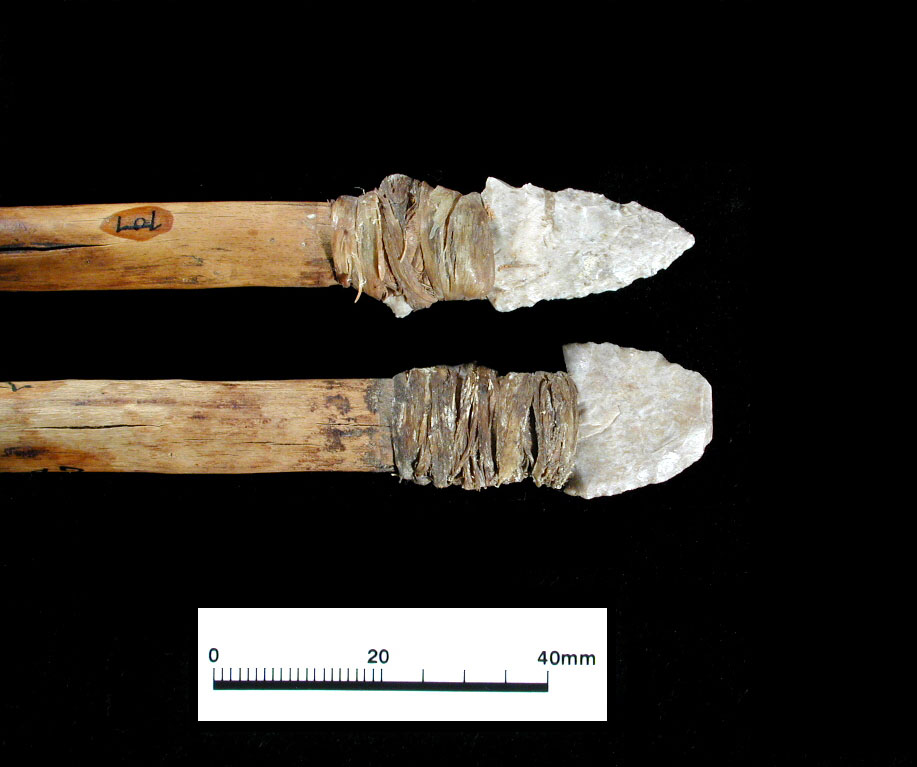
Darts, with chipped stone
points still hafted to the foreshafts, may have been among the earliest ritual deposits at Ceremonial Cave. Results of recent analyses of the darts, including X-ray computer tomography scans and AMS radiocarbon dating, are reported in the Hafted Dart Points section of this exhibit. Photo by Milton Bell. TARL Collections. |
|
 University of Texas at Austin
 College of Liberal Arts