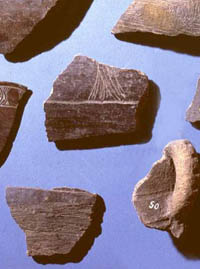
Distinctive potsherds such as these
fragments of Late Caddo pottery from the A.C. Saunders
site allow archeologists to estimate the date of Caddo
settlements. TARL archives. Click to see full image.
|
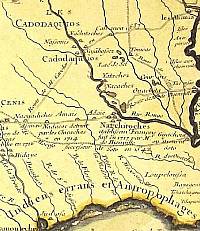
Map showing Native America as perceived
by the French in the early 18th century. This was one
of the first reasonably accurate depictions of the Mississippi
and its tributaries including the Red (Rogue) River.
The locations of Cadohadacho (Cadodaquios), Hasinai
(Les Cenis), and Natchitoches are shown. From Carte
de la Louisiana et du Cours du Mississipi, by Guillaume
Delisle, 1718.
|
|
Over 150 generations of Caddo people have lived
and died since the time more than 3,000 years ago (perhaps
much more) when the ancestors of the Caddo split from the
ancestors of the Northern Caddoan groups (see Caddoan
Languages and Peoples section). Over this long span of
human history, Caddo societies have changed in all kinds of
ways, some of them fundamental. Today we have only an inkling
of most of these changes.
Archeologists find evidence of only certain
kinds of specific events, such as the burning of a house or
the burial of an individual, that leave obvious traces. Most
ordinary events and even those that must have been extraordinary
like victory celebrations, visits by the leaders of distant
groups, and the destruction of a village by a tornado, leave
few traces that an archeologist can recognize. Similarly,
most individuals are invisible in the archeological record.
The only individuals who stand apart in prehistory are those
whose burials we find. Archeologists can recognize patterns
and detect trends through time, but without written or remembered
history to guide us, our view of prehistory is very broadsort
of like flipping through a history book and seeing only the
chapter titles and a few pictures.
To cope with uncertainty and information gaps,
archeologists construct chronologies (timelines) such as the
one presented below. While such a linear concept of time is
useful to scientists and historians, it would have been foreign
to the ancient Caddo. In most traditional Native American
societies, time was perceived as cyclical and reoccurring.
It was measured and marked by moons, seasons, generations,
and transforming events such as massive floods, celebrated
victories, the founding of a new village, or the death of
a charismatic leader.
Unfortunately, knowledge of most of the transforming
events in Caddo history has been lost, leaving us with a mix
of faint surviving memories, dance and song tradition, a precious
few detailed early written accounts, and an ever-growing mass
of archeological data from hundreds of archeological sites
linked to the Caddo. This latter may sound impressive, but
most such archeological sites are places where fragments of
Caddo-style pottery have been found on the surface and little
investigation has been carried out. Even with the relatively
few sites that have seen extensive archeological research,
it is often difficult to determine precisely when the sites
were occupied. Dating is almost always an exercise in approximation
in archeology. Even the radiocarbon dating technique yields
only statistical estimates with centuries-long standard error
ranges, rather than precise dates.
Our knowledge of the later history of the Caddo,
after Europeans arrived and began recording information, is
much fuller, but still very incomplete. Europeans only wrote
about what they happened to see or learn that interested or
concerned them. And they always saw the Caddo through the
eyes of strangers in a strange land. As we move toward the
present, our view of history becomes sharper and sharper as
we listen to Caddo voices and compare what they say to what
various officials, travelers, and neighbors wrote. Maps, paintings,
photographs, and voice recordings all add critical knowledge.
With these caveats in mind, we present a culture
history timeline that summarizes some of the major changes
through time. In this chart you will notice that the earlier
periods are longer and are often rounded off into centuries
or even thousands of years. This reflects the lack of precision
of our dating methods. Note also that some of the periods
shown below overlap with one another. This is because time
periods are abstract approximations that cut up time into
neat little blocks out of convenience; in reality things don't
always occur in an orderly linear succession or occur simultaneously
from place to place. Even today in the Digital era, there
are still millions of people across the world that do not
have electricity or running water, technological advances
that most of us take for granted. This example reminds us
that technological and cultural changes typically take decades
or centuries to spread, even today.
|
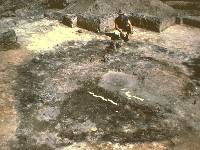
The remains of this burned structure
represent a specific event, the ritual destruction of
a small temple followed by the intentional burial of
the remains with a new layer of earth. Two successive
temples, both burned and buried, were found within and
beneath a small Late Caddo mound at the Harroun site
in Upshur County, Texas. TARL archives.
|
| As
we move toward the present, our view of history becomes
sharper and sharper as we listen to Caddo voices and compare
what they say to what various officials, travelers, and
neighbors wrote. |
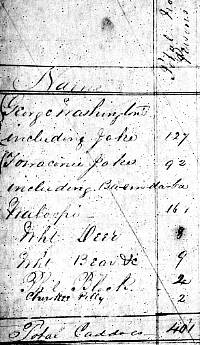
The 1873 census records a total of
401 Caddos, including 116 men, 139 women, 86 boys, and
60 girls as well as 2214 horses, 1032 cows, and 1293
hogs. Courtesy Cecile Carter.
|
|
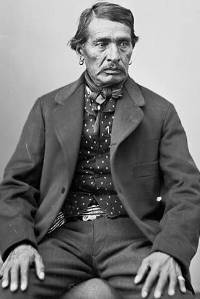
Sho-ee-tat, George Washington, was an active
leader of the Whitebead Caddo band before, during, and after
the Civil War. 1872 portrait taken when delegation visited
Washington. National Anthropological Archives.
|
|
 |
Caddo Timeline |
 |
|
|
|
|
Late Archaic |
2000 B.C. to 200 B.C. |
|
The early ancestors of the Caddo were hunter-gatherers,
who moved from place to place hunting and trapping
wild animals and gathering the seeds, nuts, fruits,
and roots of wild plants. Archaic hunters used
the atlatl (spear-thrower) and dart to kill their
favorite prey, white-tailed deer. By 2,000 B.C.,
people living not far to the north and east (in
Missouri, Illinois, and Kentucky) began experimenting
with gardening. By selecting the best stock, they
gradually developed the first domesticated forms
of oily and starchy seeded plants such as squash,
goosefoot, and sunflower. Some of the Late Archaic
groups in the Caddo Homeland may have begun small-scale
gardening as well. Part-time gardeners or not,
Late Archaic peoples seem to have increased their
numbers and put down roots. The intensive harvesting
of hardwood nuts, such as hickory and walnut,
combined with deer hunting and a host of other
food resources, apparently provided enough surplus
food for people to begin staying longer at one
place. |
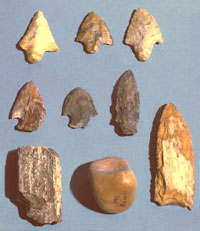
Archaic and Woodland stone
tools from the Coral Snake Coral Snake Mound on
the Louisiana side of the Sabine River under what
is now Toledo Bend Reservoir. |
|
|
|
Woodland (Early Ceramic) |
500 B.C to A.D. 800 |
|
Continuing a pattern begun in Late Archaic times,
Woodland-period Caddo ancestors gradually shifted
from being mobile hunter-gatherers to increasingly
settled villagers who planted domesticated crops
to supplement wild foods, a change with profound
consequences. With agriculture and settled life
came the ability to produce and store surplus
food, higher population levels, and the need for
new ways of organizing, integrating, and protecting
society. The finding of artifacts in graves made
of exotic materials from sources hundreds of miles
away, shows that Fourche Maline and Mossy Grove
peoples living in the Caddo Homeland were linked
to other peoples across much of the Eastern Woodlands.
In this sort of long-distance trade (down-the-line
exchange) the exotic goods were probably given
leader to leader to further ritual and social
ties, not economic ties. The Woodland period also
saw the introduction of pottery making from the
Southeast, as well as, around A.D. 500, a new
weapon system, the bow and arrow (probably from
the Southwest). |
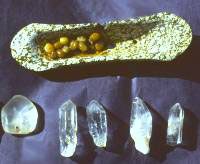
Woodland period exotic artifacts
from the Jonas Short Mound located on the Angelina
River under what is today Sam Rayburn Reservoir
in east Texas. |
|
|
|
Emerging Caddo |
A.D. 800-1000 |
|
Around 1200 years ago, early Caddo society began
to crystallize as one of the earliest Mississippian
cultures in the Southeast. Among the many villages,
some emerged as ritual centers, special places
where religious and political leaders lived. Early
ritual centers were places where temples and other
special buildings stood, sometimes on top of earthen
mounds. Temple and burial mounds were sometimes
arranged around open plazas, where the peoples
gathered on solemn and festive occasions. During
this time, complex religious and social ideas
took hold, including the notion that some people
and certain lineages (kin groups) were more important
than others. Evidence of these changes are seen
most clearly in large tombs thought to contain
adult male leaders accompanied by retainers or
family members sacrificed in their honor and fancy
grave offerings including obvious symbols of authority
and prestige. |
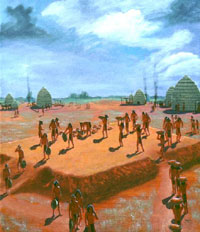
Artist's depiction of work
party piling up basket loads of earth to form
an earthen mound at an early Caddo ritual center. |
|
|
|
Early Caddo |
A.D. 1000-1200 |
|
By 1000 years ago, Caddo society can be said
to have entered its heyday, an era of unprecedented
wealth, population, and prestige that lasted over
600 years and was still underway in A.D. 1542
when Caddo peoples were first encountered by Europeans.
The Caddo were the westernmost people of the Mississippian
world, an ethnically and politically fragmented
realm that stretched eastward to Georgia and northern
Florida and as far north as Illinois and Wisconsin.
Major Caddo ritual centers in most parts of the
Caddo Homeland, especially along the Red River,
were the principal places of small, independent
societies. The Caddo had developed a distinct
pottery tradition and produced extremely fine
pottery, no doubt the envy of neighbors far and
wide. Overall, the Early Caddo period seems to
have been a time of cultural unity during which
Caddo groups in many areas did many things the
same way such as pottery making and burying their
dead. |
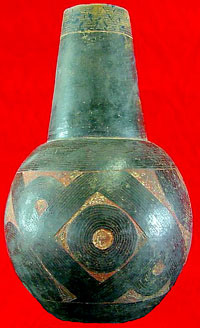
Holly Fine Engraved bottle
from an Early Caddo tomb at the George C. Davis
site, Cherokee County, Texas. |
|
|
|
Middle Caddo |
A.D. 1200-1400 |
|
As Caddo peoples grew more numerous, more and
more villages, hamlets, and farmsteads were established
throughout the Caddo world. It was at this time
that corn became the mainstay crop for most Caddo
groups, a change that probably helps explain why
Caddo settlements became smaller and more spread
out. People lived among their cornfields. At the
north end of the Caddo world the site of Spiro
on the Arkansas River reached its zenith as an
important trading and ritual center sitting strategically
at the choke point of a natural transportation
route (the Arkansas Valley) between the core of
the Mississippian world to the east and the Buffalo
Plains to the west. The Middle Caddo period is
also a time during which Caddo potters experimented
a great deal with different shapes and designs. |
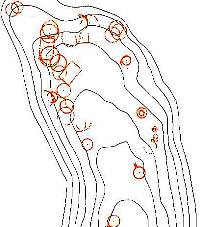
Map showing part of the "footprint"
of the Middle Caddo period Oak Hill Village site
in Rusk County, Texas. |
|
|
|
Late Caddo |
A.D. 1400-1600 |
|
Caddo population peaked after A.D. 1400, with
Caddo settlements built throughout the Caddo Homeland
including many places that had not been settled
before. Ritual mound centers seem to have become
less important in some areas. By Late Caddo times,
instead of broad cultural unity, there are many
distinct local traditions, pronounced variations
on the theme of being Caddo. The increasing reliance
on corn agriculture and high population levels
resulted in declining health among Caddo people.
The east-west trade brought small quantities of
marine shells, turquoise, cotton, and Southwestern
pottery to the Caddo Homeland from as far west
as the Pacific ocean as well as trade pieces from
the Mississippi Valley. |
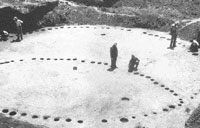
WPA workers uncovering the
outline of an enormous Late Caddo temple structure
within an earthen mound at the Hatchel site on
Red River near Texarkana. The site is thought
to be the location of the Upper Nasoni village
visited in 1691 by the Teran Expedition. |
|
|
|
European Invasion |
1542- 1730 |
|
The first Europeans to set foot in the Caddo
Homeland were Spaniards who were members of the
De Soto entrada in 1542. They did not stay long
and well over a century would pass before Europeans
returned to the Caddo world. In the intervening
period, the seeds of profound change began to
reach the Caddo: Old World diseases, plants (such
as peaches and watermelons), animals (especially
horses), and metal tools and weapons. In the late
1600s, the Spanish entered the region from the
southwest and the French from the Mississippi
Valley. They established missions and trading
posts and competed with one another for control
over the Caddo domain. Recurring diseases (like
smallpox) continued to decimate Caddo populations.
Rival Indian groups, now equipped with guns, encroached
from the east. Yet this is the very period during
which the Caddo entered written history and the
period upon which much of our understanding about
Caddo life is based. Early chroniclers encountered
at least two dozen named, independent Caddo groups,
some speaking separate dialects of a common language. |
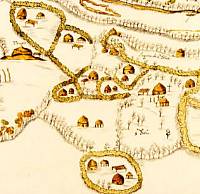
Drawing of Upper Nasoni village
on Red River by the Teran Expedition, 1691. |
|
|
|
European Colonization |
1730- 1800 |
|
As Europeans and their descendants colonized
North America, Caddo societies grappled with catastrophic
changes caused by rapid population loss, incursions
of enemies from the north and east (especially
the Osage), mounted raiders from the west (especially
the Apache), and with a changing economy. Caddo
groups became middlemen and active partners in
trade, especially with the French and French allies
such as the Tunica. Caddo groups formed alliances
in an attempt to cope with massive population
loss and threats from encroaching enemies. |
Glass trade beads were among
the European goods obtained by Caddo groups from
the French in trade for deer and buffalo hides,
horses, and Apache slaves. |
|
|
|
Anglo-American Conflict |
1800-1859 |
|
The relentless push of Anglo-American settlers from
the east forced the Caddo to abandon much of their homeland
as they grew smaller and smaller in number, with the
remnant groups banding together for survival. |
|
|
Louisiana Treaty of Cession |
1835 |
|
Given no choice, Caddo groups agreed to give
up a million acres of their traditional lands
in present day Louisiana and Arkansas and move
eastward into Texas in exchange for modest payments,
only some of which were ever made. The forced
exodus began a 20-year period during which the
Caddo had no permanent home. Relentless Anglo
settlement from the east pushed Caddo groups westward
out of their homeland into north-central Texas. |
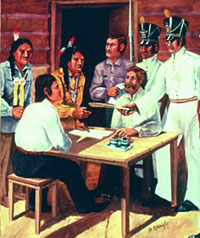
With the signing of the Treaty
of Cession in 1835, the Caddo transferred nearly
a million acres of their land to the United States. |
|
|
|
Brazos Reserve, Texas |
1855-1859 |
|
Finally the new state of Texas set aside a small
reserve on the Brazos River about 75 miles west
of Fort Worth for the dwindling groups of Caddo,
Wichita, and other tribes. Hostile settlers in
the area soon forced the Caddo to flee to the
Indian Territory (today's Oklahoma) where they
were to be given land with the Wichita. Major
Robert S. Neighbors, the federal Indian Agent
who protected and led the Caddo and Wichita to
their new home, was killed by an Indian-hating
settler upon his return to Texas. |
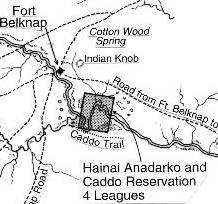
Redrawn 1854 map showing location
of Brazos Reservation. |
|
|
|
Civil War |
1860-1867 |
| Distrustful of southerners,
most of the surviving Caddos moved to Kansas during the
war. Some stayed in Oklahoma. |
|
|
Resettled in Oklahoma |
1868 |
|
Caddo people returned to Indian Territory to
find that that most of their lands had been given
to Plains Indian groups. The Caddo finally settled
down on the remaining land near the towns of Binger,
Fort Sill, and Anadarko, Oklahoma. In the 50 years
following the Civil War, the Caddo learned to
live in west-central Oklahoma, often intermarried
with members of other tribes, slowly increased
their numbers, and struggled to cope with assimilation
into American society. |
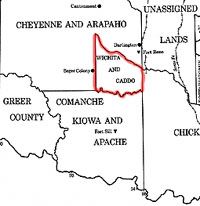
Map of the Oklahoma Territory,
1866-1889, showing Caddo and Wichita lands. |
|
|
|
Caddo Tribe |
1874 |
|
For the first time, the Caddo are recognized
as a single tribe or nation, a change brought
about by the necessity of dealing with the United
States government. |
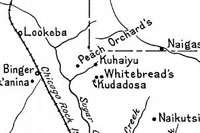
Map of Caddo County, Oklahoma
showing area where Caddo families settled. |
|
|
|
Allotment |
1889-1901 |
|
On order of the U.S. government, Caddo tribal
lands, like those of certain other tribes, were
parceled out to each adult Caddo, 160 acres each.
White settlers were given everything left over
(most of the Caddo land). This was a deliberate
strategy intended to seize more Indian lands and
prevent tribes from reorganizing and to force
Indian peoples to assimilate into American society. |
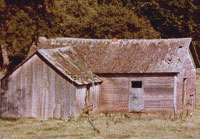
Plank house dating to the late
1800s that was built on the allotment of Fannie
Brown. The property is still in the hands of her
descendants. |
|
|
|
Tribal Charter |
1936 |
|
The Caddo adopted a Tribal Charter and set up a formal
government with an elected chairman and tribal council.
|
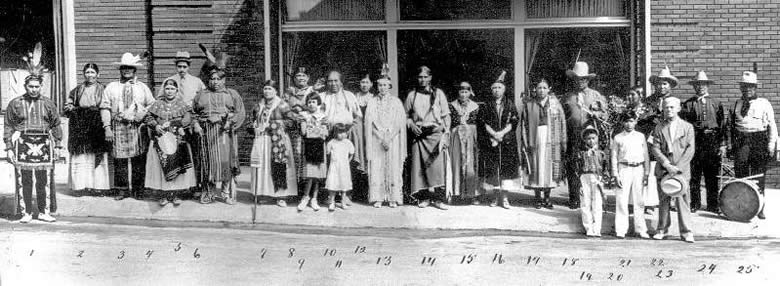
Delegation of Caddo Indians to the
1935 Shreveport Centennial Exposition honoring 100th
anniversary of the 1835 Treaty of Cession. |
|
|
NAGPRA Enacted |
1990 |
The enactment
of the Native Americans Grave Protection and Repatriation
Act (NAGPRA) gave the Caddo Nation a greater voice in
their cultural patrimony and deciding the fate of the
bones, grave goods, and sacred items of Caddo ancestors
found on federal and tribal lands or held in federally
funded institutions. |
|
|